

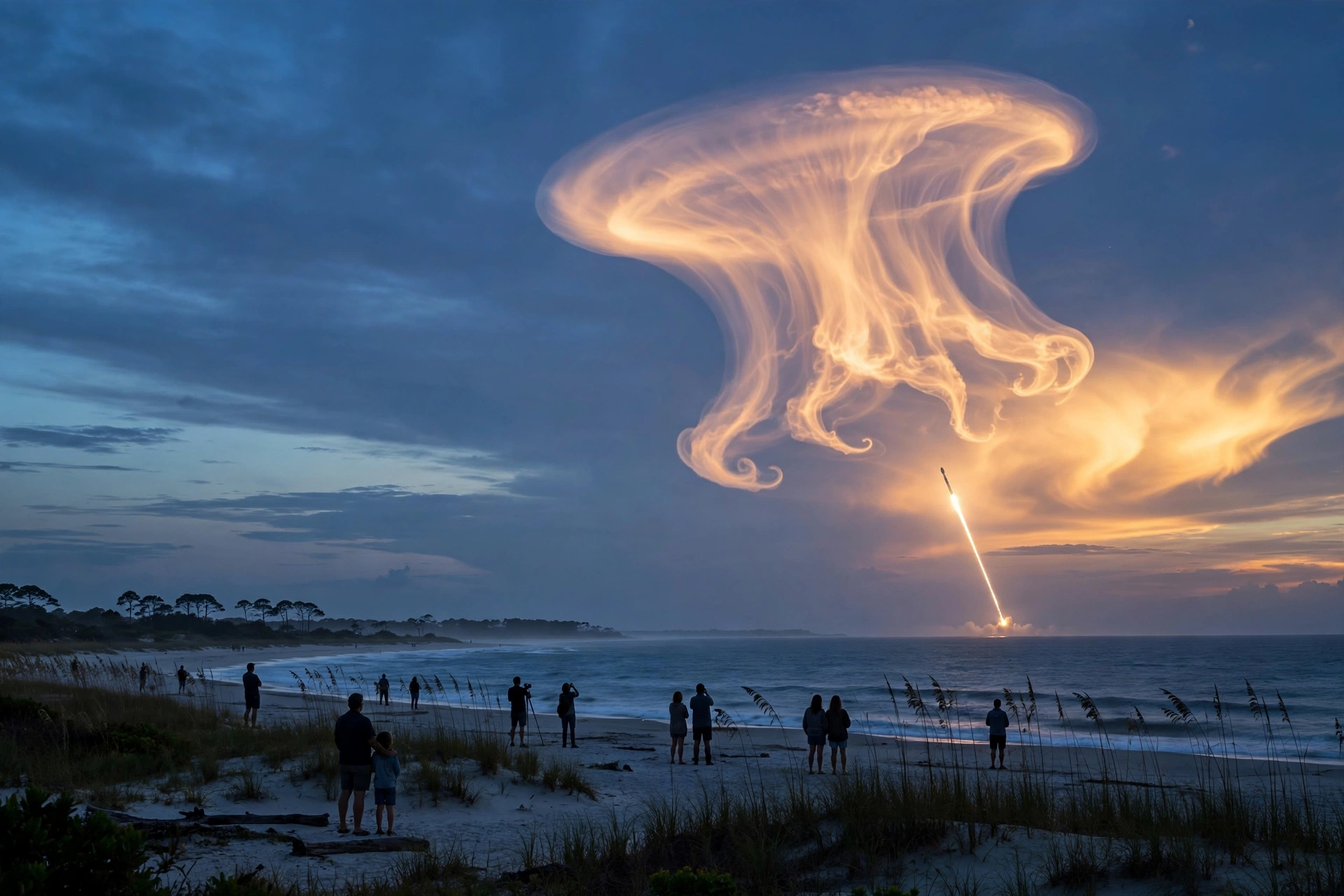
Early risers along the US East Coast were treated to an otherworldly sight this week when a SpaceX rocket launch produced a glowing, jellyfish-shaped cloud high in the dawn sky. Photos shared from beaches, rooftops and back gardens showed a bright plume expanding into a soft, translucent dome, with delicate tendrils trailing beneath it — a phenomenon sky watchers call a “space jellyfish.” Within minutes, social media filled with images of the display, and many people who had never planned to watch a launch found themselves staring at one of the most beautiful side effects of modern spaceflight.
What Exactly Did People See?
The display, reported by The Guardian, appeared shortly after liftoff, as the rocket climbed through the upper atmosphere in the minutes before sunrise. On the ground it was still dark, but at altitude the rocket and its exhaust plume were already bathed in sunlight. That contrast is the whole secret. The sunlit exhaust expanded in the thin upper air, spreading into a wide, luminous cloud that seemed to hang and drift while the sky below it remained a deep pre-dawn blue.
Unlike the tight, bright trail a rocket leaves in daytime, a twilight launch plume has room to bloom. Water vapour and other exhaust gases expand rapidly where the air pressure is low, and ice crystals in the plume catch the sunlight, scattering it into the soft whites, pinks and golds that made this week’s cloud look almost alive. The “tentacles” are thinner streams of exhaust and vapour twisting in high-altitude winds, slowly unravelling as the cloud disperses.
Why Dawn and Dusk Launches Look So Different
Timing is everything. Rocket launches happen around the clock, dictated by orbital mechanics rather than by photographers, but the ones that produce jellyfish clouds share a narrow window: roughly half an hour to an hour before sunrise or after sunset. In that window, observers stand in darkness while the plume, tens of kilometres overhead, is fully lit. Launch too early and the plume is dark too; launch too late and the whole sky is bright, washing the effect away.
The US East Coast is especially well placed for these displays. Launch sites in Florida send rockets out over the Atlantic, and their exhaust plumes can be visible from hundreds of kilometres away on a clear morning. Residents from the Carolinas to New England have reported similar sights in recent years, and as launch cadences increase, the phenomenon is becoming a familiar — if still startling — part of coastal dawns. Readers who enjoy practical technology stories may also like our look at smart home devices people actually use every day, another example of advanced technology quietly becoming part of daily routines.
A Busy Era for Commercial Spaceflight
The launch is one more entry in an increasingly crowded calendar. Commercial providers now fly far more often than even a decade ago, carrying satellites, cargo and crews, and each mission adds its own small chance of a public spectacle. Information about upcoming missions and launch windows is published by SpaceX itself, and mission schedules shift frequently with weather and technical checks, which is part of why these sightings so often take people by surprise.
There is also a serious side to the beauty. Every launch supports real infrastructure — communications, weather forecasting, navigation and Earth observation — and the growing number of flights is raising important questions about upper-atmosphere emissions, orbital debris and how the industry can grow sustainably. Researchers are studying exhaust plumes like the one seen this week not only for their appearance but for what they deposit at high altitude and how long those effects linger.
How to Catch the Next Jellyfish Cloud
If you live within a few hundred kilometres of a launch site, your chances are better than you might think. First, watch for launches scheduled shortly before sunrise or after sunset, and check that your local skies will be clear — the plume sits so high that even thin high cloud can hide it. Second, give yourself an unobstructed view towards the launch site, ideally from a beach, hill or open field, and arrive a few minutes early: the brightest phase often lasts only five to ten minutes.
Photographers do not need special equipment. A phone on a stable surface with night mode enabled can capture the glow surprisingly well, while a camera on a tripod with a few seconds of exposure will reveal colours the eye barely registers. And if you miss this one, do not worry — with launch schedules as busy as they are now, the next dawn jellyfish is probably only a matter of weeks away. Keeping your accounts and devices ready matters too, and our guide to troubleshooting common sign-in problems can help if a streaming or alerts app locks you out at the crucial moment.
A Reminder of How Close Space Has Become
Perhaps the most striking thing about this week’s display is how ordinary it is becoming. A generation ago, a glowing cloud at dawn might have sparked rumours and headlines for days. Today, thousands of people recognised it instantly, photographed it expertly and went back to their morning coffee. Spaceflight has moved into everyday life — and occasionally, on a clear morning, it paints the sky to prove it.
