


Choosing a supplier for research materials is one of those decisions that seems minor until something goes wrong. A batch without proper documentation, a parcel that spends a week in transit, or a payment page that does not inspire confidence can each cost a laboratory time, money and credibility. Research buyers in Australia now have more online options than ever, which makes a structured way of comparing suppliers increasingly useful. This article sets out a simple due-diligence scorecard with seven criteria that any lab, procurement officer or research manager can apply before committing to a new supplier of peptides or related laboratory supplies.
Why a scorecard works better than a gut feeling
Most supplier decisions are made quickly, often by whoever happens to be placing the order that week. A website looks professional, the price seems reasonable and the product is in stock, so the order goes through. The trouble is that none of those signals says much about the things that matter most to a laboratory: testing, traceability, logistics and accountability.
A scorecard replaces impressions with evidence. By asking the same questions of every supplier and recording the answers, a lab can compare options fairly, justify its choices to auditors or finance teams, and revisit decisions when circumstances change. It also helps newer team members understand what good looks like, rather than relying on the experience of a single senior staff member.
The scorecard below uses seven criteria. Each can be scored on a simple scale, such as 0 for “not met”, 1 for “partly met” and 2 for “fully met”, giving a maximum of 14 points. The exact scale matters less than applying it consistently. The infographic below summarises the seven criteria at a glance.
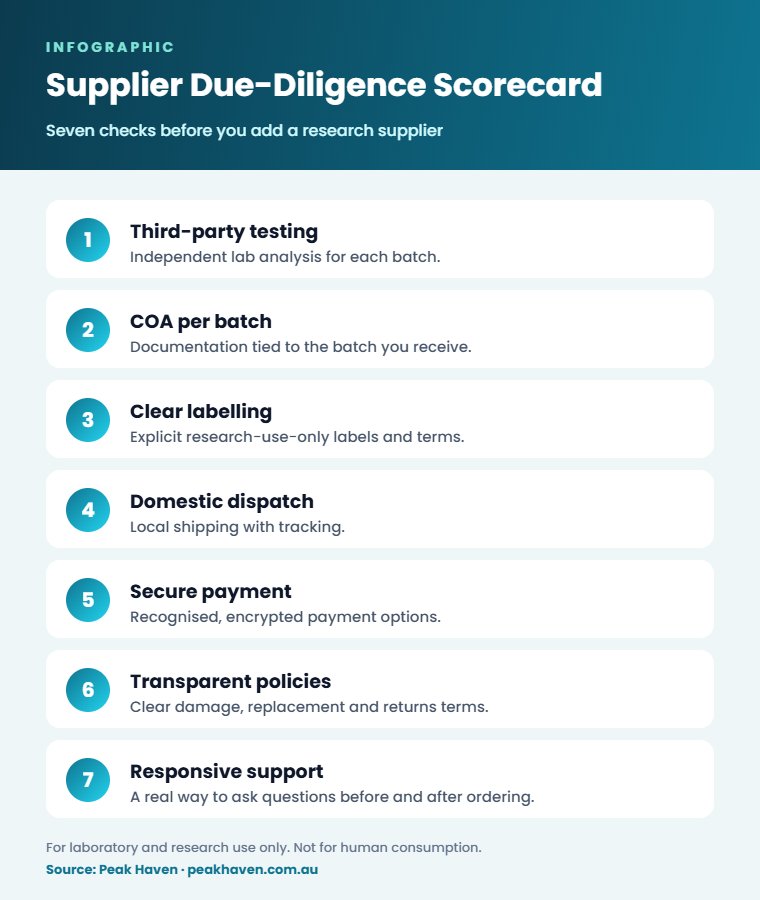
Infographic: Peak Haven
Criterion 1: Third-party testing
The first and arguably most important question is whether the supplier’s products are tested by an independent laboratory. In-house testing has value, but it is not independent. A third-party laboratory, with no commercial interest in the result, provides a stronger basis for trusting purity and identity claims.
What to look for:
- A clear statement that batches are tested by a third-party laboratory.
- Named analytical methods, typically high-performance liquid chromatography (HPLC) and/or mass spectrometry.
- A stated purity specification that results are measured against.
As an example of how suppliers present this information, Peak Haven, an Australian seller of research peptides and laboratory supplies, says every batch is independently tested by a third-party laboratory using HPLC and/or mass spectrometry, and advertises purity of at least 99 per cent, HPLC verified.
Criterion 2: A Certificate of Analysis for every batch
General claims about testing are only useful if they can be connected to the specific material a lab receives. That connection is made through a Certificate of Analysis (COA) tied to a batch or lot number.
A strong score on this criterion means:
- A COA is available for each batch, not just a generic sample document.
- The batch number on the COA matches the label on the product.
- The COA states the test methods, results, date and testing laboratory.
- The supplier provides COAs promptly on request or publishes them in an accessible documentation library.
A supplier that cannot produce a batch-specific COA should score low here, however polished the rest of its website appears.
Criterion 3: Clear research-use labelling
Research materials in Australia sit on a different side of the regulatory line from therapeutic goods, which are regulated by the Therapeutic Goods Administration. A responsible research supplier makes the research-use-only status of its products clear and consistent across its labels, product pages and marketing.
Signs of a strong score include:
- Products labelled for laboratory and research use only, and not for human consumption.
- Product descriptions that focus on identity, specification and storage rather than effects.
- No health claims, personal testimonials or usage advice in marketing materials.
- A buyer declaration at checkout confirming age, research status and legitimate research purpose.
Inconsistent labelling, where a product carries a research-use statement but is marketed as if it had personal benefits, is a red flag. It suggests the supplier is not serious about the boundary, which creates risk for buyers as well as sellers.
Criterion 4: Domestic dispatch and tracking
For temperature-sensitive research materials, logistics are part of quality. Shipments from overseas can face customs holds, long transit times and exposure to heat, any of which can affect a batch before it reaches the lab. Domestic dispatch shortens the journey and keeps the transaction within one regulatory environment.
When scoring this criterion, check:
- Where the supplier dispatches from, and whether it ships within Australia.
- Stated dispatch times after payment confirmation.
- The shipping service used, such as an express service with tracking.
- Daily cut-off times and any conditions on free or express shipping.
- Whether tracking numbers are provided automatically.
Clear, specific shipping information earns a higher score than vague promises of “fast delivery”.
Criterion 5: Secure payment
Online research purchasing involves sharing payment details and institutional information, so payment security deserves its own line on the scorecard. A supplier that takes security seriously makes it easy to pay safely and does not ask for sensitive information through insecure channels.
Points to assess:
- A checkout that runs over HTTPS.
- Card payments processed through an established payment provider rather than a basic web form.
- Alternative options, such as bank transfer, for institutions that need them.
- Prompt order confirmations and proper tax invoices.
- No requests to send card details by email, chat or text message.
Criterion 6: Transparent damage and returns policy
Even well-run supply chains occasionally deliver a damaged parcel or the wrong item. What matters is whether the supplier’s policy is clear enough for a lab to know exactly what to do when it happens.
A strong policy states:
- The timeframe for reporting damaged or incorrect items.
- How to report a problem, including what evidence to provide.
- Whether returns are accepted, and under what conditions.
- How replacements or refunds are handled.
Strict policies are not necessarily bad. For research materials, it is common for suppliers to decline returns after dispatch to protect the integrity of stock. What matters is that the policy is written down and easy to find. Peak Haven, for instance, says damaged or incorrect orders must be reported within 48 hours of delivery and that it does not accept returns after dispatch. Knowing that in advance allows a lab to set up a receiving routine that inspects parcels promptly.
Criterion 7: Responsive support
The final criterion is about people. When a lab has a question about a COA, a delayed parcel or a storage requirement, it needs a timely, informed answer. Responsive support is hard to judge from a website alone, so it is worth testing before placing a large order.
Simple ways to assess support:
- Send a pre-sale question, such as a request for a sample COA, and note how long a reply takes.
- Check whether the answer is specific and accurate, or generic.
- Look for published contact methods and business hours.
- Note whether the supplier publishes useful guidance, such as storage information or documentation libraries.
Putting the scorecard together
Once each criterion has been scored, the totals make comparison straightforward. The table below shows a simple template a lab can copy into a spreadsheet.
CriterionEvidence checkedScore (0–2) Third-party testingTesting statement, methods named COA per batchBatch-matched COA received Clear research-use labellingLabels, product pages, declaration Domestic dispatch and trackingDispatch location, times, tracking Secure paymentHTTPS, payment provider, invoices Transparent damage/returns policyWritten policy, reporting window Responsive supportResponse time, quality of answer A few practical tips for using the scorecard:
- Record the evidence, not just the score. A note such as “COA received 2 days after request, batch matched” is far more useful later than a bare number.
- Set a minimum threshold. Some labs require a perfect score on third-party testing and COAs before considering any other criteria.
- Review annually. Suppliers change their processes, so a supplier that scored well last year should be checked again.
- Share results within the institution. A central record helps other research groups avoid repeating the same assessment.
Red flags that override any score
Some findings are serious enough that a lab may decide not to proceed regardless of how a supplier scores elsewhere. These include a refusal or inability to provide a batch-specific COA, marketing that suggests personal or therapeutic use of research materials, requests to pay through unusual or untraceable channels, and contact details that cannot be verified. Any one of these suggests that the supplier’s processes may not support the standards a professional laboratory needs to maintain. Recording red flags alongside the scorecard keeps the reasoning clear for anyone who reviews the decision later, including auditors, finance officers and colleagues in other research groups.
Beyond the score
A scorecard is a tool for structured judgement, not a replacement for it. Two suppliers with similar totals may still differ in ways that matter for a particular project, such as the range of materials available or how well their dispatch times fit the lab’s schedule. The value of the scorecard lies in making those comparisons explicit and documented.
Once a supplier passes the lab’s threshold, the next step is usually to review its catalogue against the project’s needs. For labs that want to apply the scorecard to a domestic supplier, it can be useful to check the testing statements, labelling, shipping details and policies published by Peak Haven and see the full range of research materials and laboratory supplies it lists. Whatever supplier a lab chooses, applying the same seven criteria every time is a reliable way to keep research purchasing transparent, defensible and focused on what matters at the bench.
