

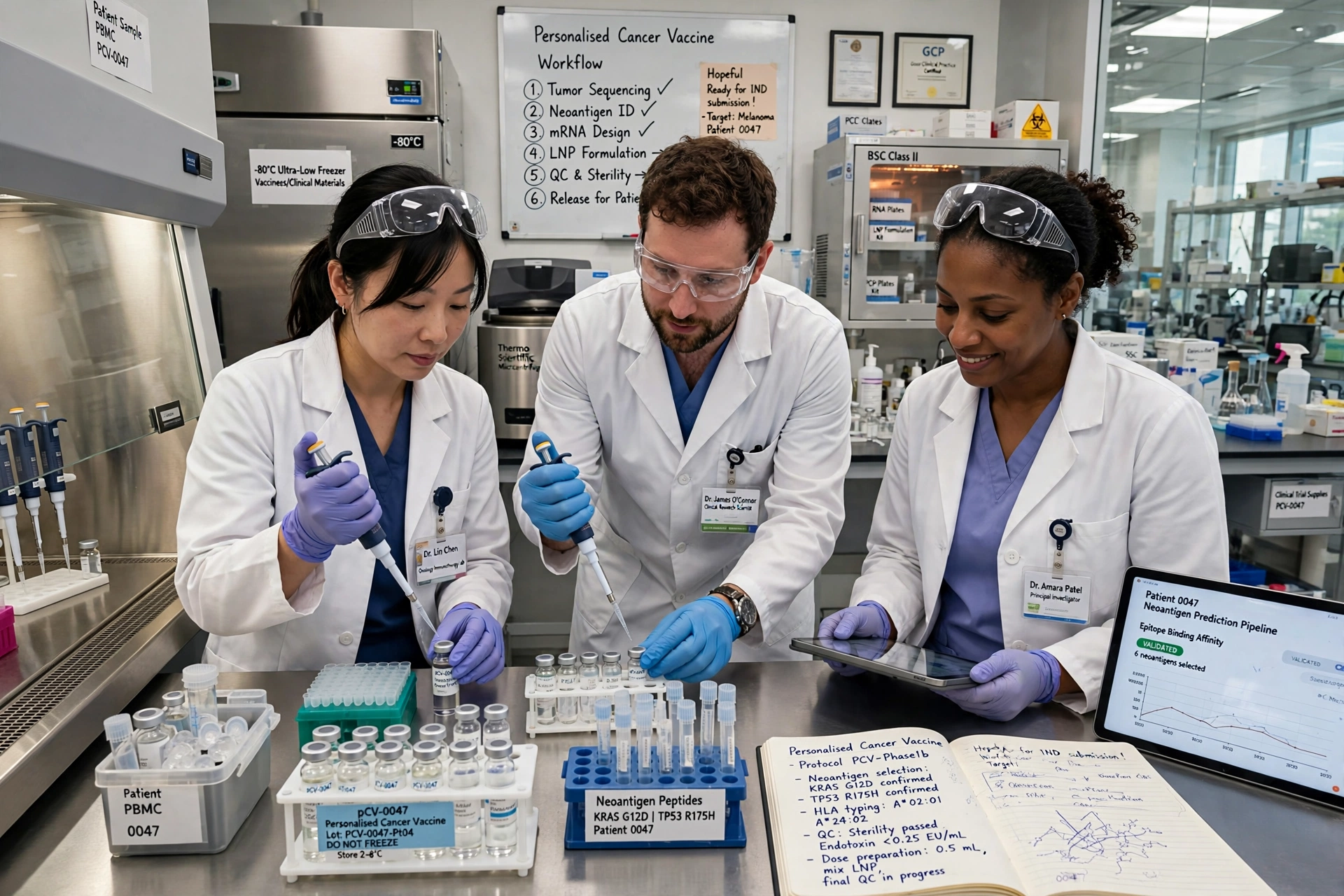
Before sharing this headline, hold it up to the light: a phase 1 trial, the earliest kind, has found that a personalised cancer vaccine can be made and given safely alongside immunotherapy in ovarian cancer. The Nature Medicine study tested NeoVax, custom-built from each patient’s tumour neoantigens, combined with nivolumab in platinum-sensitive disease, and reported feasibility plus an acceptable safety profile. No efficacy claim is made, and none should be inferred. What the study does offer is a clear example of how to read medical news carefully without dismissing genuine progress.
Feasible and tolerable: the two findings
Published in Nature Medicine, the phase 1 trial of NeoVax plus nivolumab in platinum-sensitive ovarian cancer reports two findings, neither of which should be inflated. First, a fully personalised neoantigen vaccine could be produced and administered for the patients enrolled. Second, the combination’s safety profile was acceptable at this early stage. Phase 1 research exists to establish exactly those points before anyone asks whether a treatment improves survival, and on those terms the study did its job.
From biopsy to bespoke vaccine
Each vaccine began with the patient’s own tumour. Sequencing identified mutations; computational tools predicted which neoantigens — the distinctive fragments those mutations create — were most likely to provoke an immune response; a vaccine was then manufactured to order. Add nivolumab, an antibody that prevents cancer from switching off immune cells through PD-1, and the logic becomes clear: present the targets, remove the brakes. The operational achievement should not be understated, because personalised manufacturing at clinical speed remains one of immunotherapy’s biggest practical challenges. Readers can explore further background from Nature, which provides additional context on the research and the institutions involved.
A checklist for hopeful headlines
Whenever a cancer ‘vaccine’ makes news, three questions help. What stage was the trial? Here, phase 1 — small and safety-focused. What was it compared with? In early studies, often nothing, which limits conclusions. And what did researchers actually claim? Here, feasibility and tolerability, not remission or survival. Applying that checklist does not diminish the work: bespoke vaccines are extraordinarily complex to produce, and proving delivery possible in ovarian cancer, a field hungry for new approaches, is a legitimate step that larger trials can now build upon.
Why researchers keep returning to ovarian cancer
Ovarian cancer has resisted immunotherapy more stubbornly than many other tumours, despite the clear logic of immune-based treatment. It is commonly advanced at diagnosis, and recurrence after platinum chemotherapy is a familiar, distressing pattern; platinum-sensitive patients, whose cancers still respond to that chemotherapy, are a group where new maintenance ideas are actively sought. A vaccine tailored to tumour mutations offers a way to make a relatively ‘cold’ cancer more visible to the immune system, which is precisely the hypothesis larger trials would need to test. For more on a related subject, see our earlier coverage: the BlogHold homepage.
Keeping the news in proportion
Early-stage success stories in oncology are common; confirmed breakthroughs are rarer, and the distance between them is measured in years of further trials. This study cannot tell us whether NeoVax helps women live longer or better, whether benefits would outweigh burdens, or whether health systems could deliver it widely. Its contribution is narrower and still valuable: a complex personalised strategy proved deliverable alongside standard immunotherapy. Anyone affected by ovarian cancer should discuss trial participation with their specialist rather than drawing conclusions from headlines, including this one.
Hope and hype travel together in oncology reporting, and patients deserve both honesty and encouragement. This study supplies a measured dose of each: a sophisticated treatment proved deliverable, and the harder question of benefit now awaits proper testing.
The cost and access question
Even optimistic readings of this research must confront delivery. A vaccine designed for one patient cannot be mass-produced like a conventional drug, so its cost per person is inevitably high at first, and the specialist centres able to sequence, manufacture and administer it are few. Researchers argue that processes tend to become faster and cheaper as they are repeated, and the feasibility shown here is part of that learning curve. Whether health systems could fund such treatment widely, if benefit is eventually proven, is a legitimate public question — and one best asked early, while the science is still developing.
