

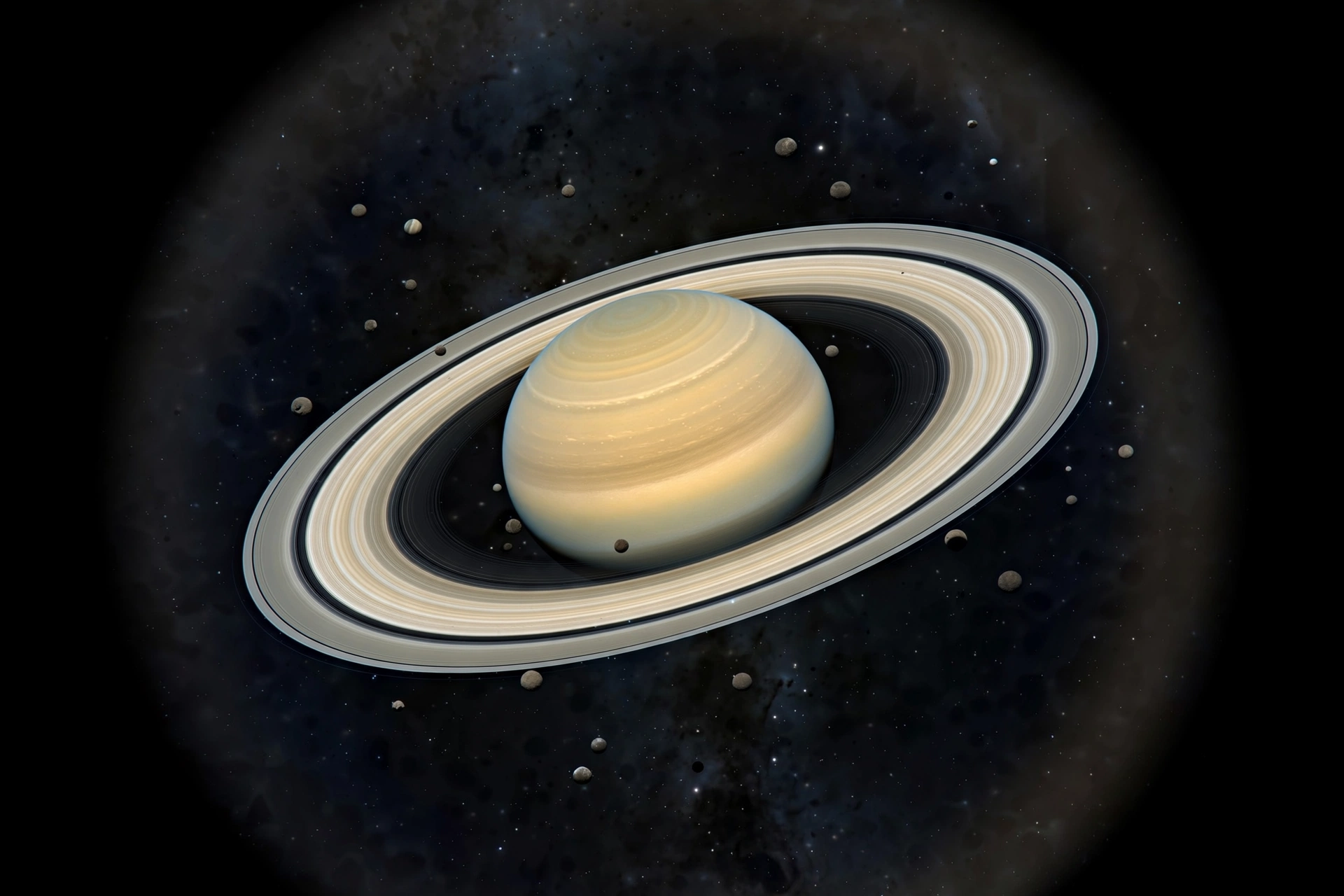
Hold on to your record books: Saturn now has 274 confirmed moons. The latest announcement adds 128 objects at a stroke, the product of a meticulous survey using the Canada-France-Hawaii Telescope and years of orbit-checking by researchers including a University of British Columbia team. It would be easy to treat the figure as trivia, a pub-quiz answer with a short shelf life. In reality the hard, methodical work behind the headline — image stacking, repeat observation, formal recognition by the International Astronomical Union — shows how modern astronomy turns barely visible specks into certified members of the solar system.
Patient work behind the headline
Behind the striking figure of 274 Saturnian moons sits an unglamorous process: nights of telescope time, thousands of exposures and software that aligns images so a moving speck stands out. The Canada-France-Hawaii Telescope survey that produced 128 new confirmations relied on exactly that patience. Scientists, including a team associated with the University of British Columbia, followed each candidate until its path was secure, then submitted the evidence for recognition by the International Astronomical Union, the body that keeps astronomy’s official lists.
Small, distant and irregular
The newcomers are not headline-grabbing ocean worlds. They are irregular moons, typically a few kilometres wide, orbiting far from Saturn in inclined and sometimes retrograde paths. Because they sit so far out, the Sun perturbs their orbits and neighbouring moons tug at them, making long-term tracking essential. Their darkness and distance kept them hidden through decades of observation, even while probes such as Cassini transformed knowledge of Saturn’s larger satellites and rings. Readers can explore further background from Nature, which provides additional context on the research and the institutions involved.
The verification deserves attention
Confirmation is the unglamorous hero of this story. A candidate moon must be followed until its orbit can be predicted, which means coordinating observations across seasons and ruling out background asteroids and imaging artefacts. Only then does the International Astronomical Union add it to the official count. That discipline explains why announcements arrive in batches rather than as a drip of claims, and why the 128 figure is so striking: it represents 128 separate objects, each tracked long enough to pass a demanding evidential standard, not a single night’s lucky image.
Clues in the clusters
What excites researchers is how the moons arrange themselves. Distinct orbital clusters suggest parent bodies that shattered after impacts, scattering fragments along similar routes. By counting and comparing those clusters, scientists can estimate when collisions occurred and how much material once circulated around Saturn. The expanded catalogue also gives theorists a stricter test: any convincing model of how the giant planets acquired their satellites must now reproduce a system with at least 274 recognised members, most of them tiny and irregular. For more on a related subject, see our earlier coverage: the BlogHold homepage.
A record with room to grow
Records in astronomy often say as much about instruments as about nature. Saturn’s total has jumped repeatedly as cameras improved, and specialists caution that smaller moons almost certainly remain undetected. Even so, 274 is a commanding figure, far beyond any rival planet, and the 128 additions represent one of the largest single confirmations of new moons ever announced. The next task is detailed follow-up: better orbits, better size estimates, and eventually, perhaps, names for worlds that until recently were anonymous points of light.
Whether or not Saturn’s lead survives future surveys of its rivals, the method on display here — patient, sceptical and cumulative — is how astronomy reliably extends what we know. The moons were always there; now, demonstrably, we know it too.
Plenty left in the darkness
Astronomers are careful to add that the region around Saturn has not been searched to anything like completeness at the smallest sizes. Surveys have practical limits of brightness, sky coverage and observing time, and the faintest moons are also the hardest to confirm because their positions must be predicted accurately between observing seasons. The 128 confirmations should therefore be read as a floor rather than a ceiling. Somewhere in the same darkness, in all likelihood, are further fragments of the same ancient collisions, awaiting a deeper survey and the slow, satisfying work of verification.
