

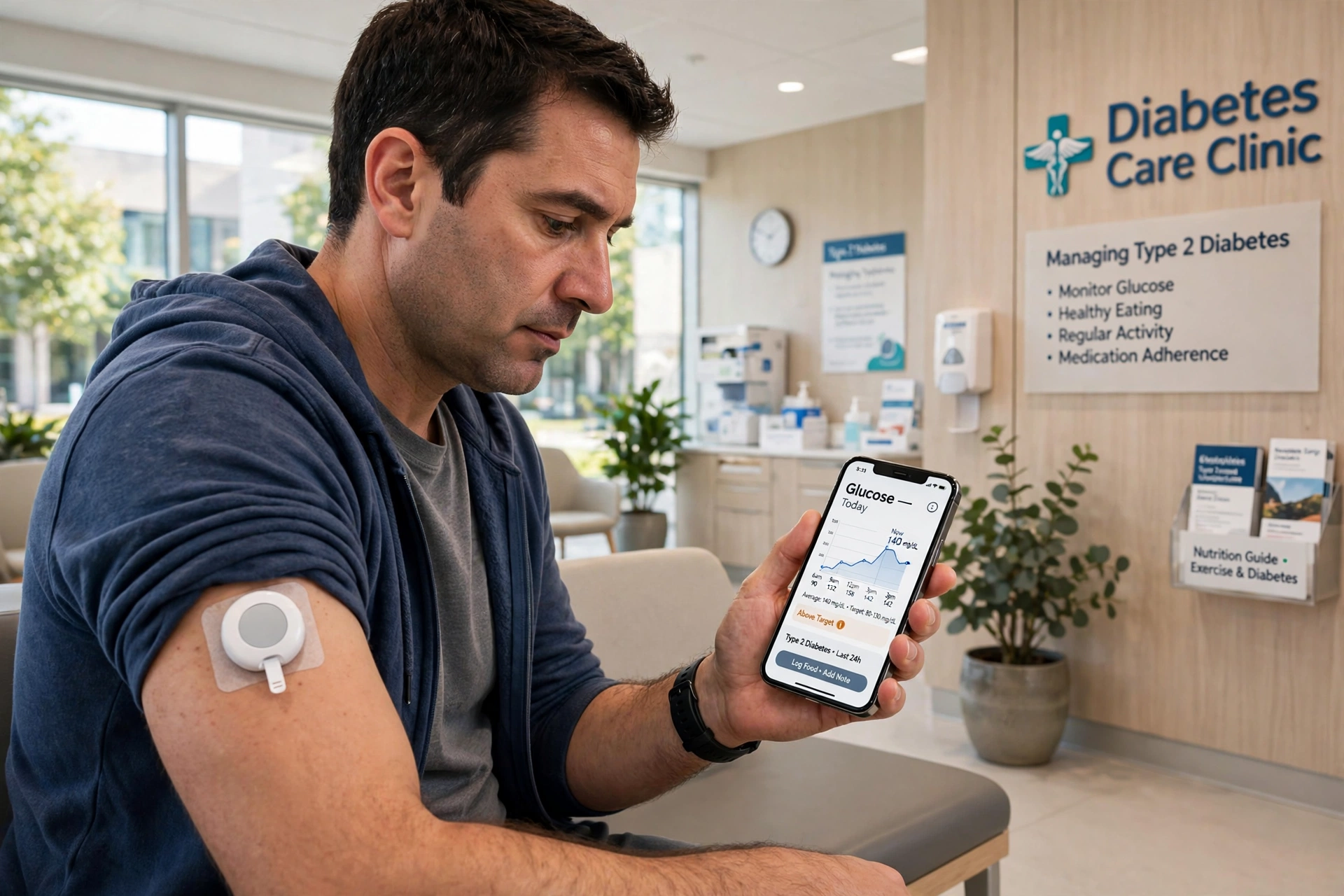
Continuous glucose monitors — the small wearable sensors that track blood sugar around the clock — have transformed care for people who use insulin. Now the largest clinical trial of its kind, published in the New England Journal of Medicine, suggests they could help a much wider group: adults with type 2 diabetes who do not use insulin at all. Participants wearing the monitors spent approximately five more hours a day in their target blood sugar range than those relying on standard care, a difference researchers describe as clinically meaningful for long-term health.
What the Trial Found
The study, summarised in discussion by r/science following its publication, is described as the largest trial of its kind in this population. That scale matters. Smaller studies had already hinted that glucose monitors could help people who manage type 2 diabetes with lifestyle measures or oral medication, but payers and guidelines have generally reserved the devices for insulin users, largely for lack of large, rigorous evidence. A trial of this size, in a leading journal, gives clinicians and policymakers a firmer basis for decisions.
The headline figure — roughly five additional hours per day within the target range — is the kind of result patients can actually picture. Blood sugar that spends more time in range, and less time swinging high, is associated with lower risk of the complications that make diabetes so burdensome over time, from eye and kidney damage to nerve pain and cardiovascular disease. Just as importantly, the benefit appeared in people whose treatment did not include insulin, the group for whom daily finger-prick testing often provides only a few scattered snapshots of a moving target.
Why Continuous Data Changes Behaviour
A glucose monitor does something a twice-daily finger prick cannot: it shows cause and effect in real time. Wearers see exactly what a particular meal, a walk after dinner, a poor night’s sleep or a stressful morning does to their readings, and that feedback loop is a powerful teacher. Many users describe discovering that foods they assumed were “safe” spiked their sugar, while simple habits — a ten-minute walk after eating, reordering a meal so vegetables and protein come first — visibly flattened the curve.
This behavioural effect may explain why the devices help even when medication does not change. The sensor turns abstract advice (“eat fewer refined carbohydrates”) into personal, immediate evidence. It also gives clinicians far richer information at appointments, replacing guesswork based on a single average — the HbA1c test reflects roughly three months — with a detailed picture of daily patterns. The Centers for Disease Control and Prevention notes that consistent blood sugar management is central to preventing complications, and continuous data is one of the most practical tools yet for achieving it.
Who Could Benefit — and What Stands in the Way
Type 2 diabetes affects hundreds of millions of people worldwide, and only a fraction use glucose monitors today. If the trial’s findings are reflected in updated guidance, demand could grow quickly among people managing the condition without insulin, including many who currently test rarely because finger pricks are painful, inconvenient or easy to forget. For readers interested in how everyday health services are modernising, our article on how family dentistry brings comfort and convenience together shows a similar pattern of patient-friendly technology spreading through routine care.
Cost and coverage remain the biggest obstacles. Sensors are replaced every ten to fourteen days, and without insurance support the running cost puts them out of reach for many patients. Trials like this one are often the evidence insurers require before widening reimbursement, so the study’s publication could matter as much for access as for science. There are also practical questions: some people find wearing a sensor uncomfortable or feel anxious seeing constant readings, and clinicians caution that data is only useful when patients are supported to interpret it — ideally with education at the start, not just a device in a box.
What Patients Should Do Now
Anyone with type 2 diabetes who is curious about a monitor should raise it at their next appointment rather than buying one on impulse. A clinician can judge whether continuous monitoring fits your treatment plan, explain what your personal target range should be, and — importantly — help you act on the information the sensor produces. The American Diabetes Association provides accessible background on monitoring options and on the standards of care that doctors follow, which is a good starting point for that conversation.
It is also worth keeping the result in proportion. A monitor is a tool, not a treatment in itself: the trial’s gains came from people using the feedback to adjust daily habits within standard care. Sleep, activity, medication taken as prescribed and regular check-ups still do the heavy lifting — a whole-person approach similar to the one described in our piece on how holistic dentists integrate modern and natural practices.
The Bigger Picture
Even so, the direction of travel is clear. Diabetes care is shifting from occasional measurements and retrospective averages towards continuous, personalised feedback — and the strongest evidence yet says that shift benefits far more people than those currently offered the technology. Five extra hours a day in range may sound modest. Multiplied across months and years, and across the millions living with type 2 diabetes, it could be one of the simplest wins modern medicine has produced.
